Cluster headache playing cards · Game three
Diagnostic Delay
A race to diagnosis. Everyone starts with nothing. The first player holding at least one card from each of the four suits is diagnosed and wins.



Set up a game
The game enforces the rules for you. Every card you draw joins your fact deck.
Computer players
Pace
Every card is explained as it is drawn: what it means and what happens to it. The game waits for you to continue.
Difficulty
Opponents take what they need from the discard pile and aim powers at whoever is closest to overload.
New to the game? The guided game plays the rulebook’s worked example: six turns, one card from each suit.

54 cards · 4 suits · 2 Jokers
How to play
The unlock sequenceFour stages. You must earn each one before the next opens.
♠
1 · Suffer Spades are open from the start. Attacks arrive uninvited. Every Spade you draw, you keep.♦
2 · Understand Diamonds unlock once you hold 2 or more Spades. You need enough attacks for the pattern to be visible.♥
3 · Treat Hearts unlock once you hold at least 1 Diamond. You have to understand the disease before you can be treated for it.♣
4 · Connect Clubs unlock once you hold at least 1 Heart. Treatment comes before community — you need a name for it to find the others.Your turn
1Draw one card. Either take the top card of the face-down pile, or take the top card of the discard pile — but you may only take from the discard if that card’s suit is unlocked for you.
2If the suit is unlocked, put the card in front of you, grouped by suit. If it is locked, put it on the discard pile.
3If the card is a Jack, Queen or King and you kept it, resolve its power now.
4Check whether you have won: one card from each suit means you are diagnosed.
5Check whether you are out: 6 or more Spades with no Diamonds means you are overwhelmed and eliminated.
6Pass to the next player.
If the draw pile runs out, shuffle the discard pile to make a new one. If that happens three times with nobody diagnosed, the player holding the most different suits wins; break a tie on total cards.Special cards and face card powersResolve the power after the card joins your collection. These powers apply in this game and no other. A♠ The Twinge Counts as two Spades when checking whether Diamonds unlock. It is still one card for the overload check.
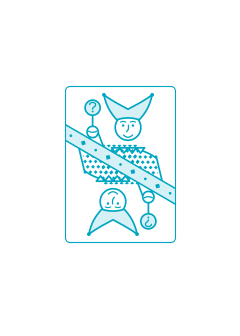 Joker · Misdiagnosis Whoever draws it loses their most recently collected Diamond, which goes to the discard pile. If you hold K♦ Circadian, or the Diamond is shielded, nothing is lost. Then discard the Joker.
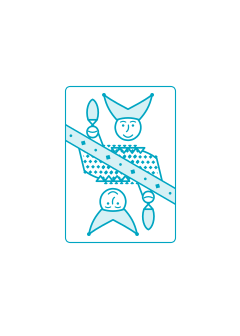 Joker · Awareness Every player, starting with you and going clockwise, immediately draws one bonus card and resolves it normally. Then discard the Joker.
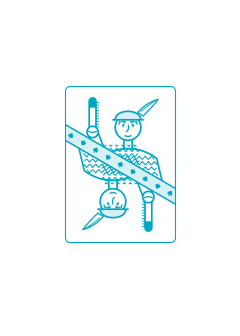 J♠ Kip Scale Choose an opponent. They immediately draw two cards, resolved by their own unlock rules. It may push them toward overload.
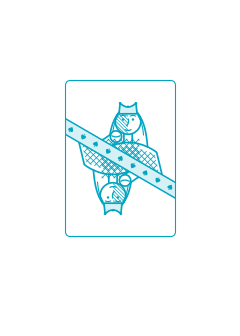 Q♠ The Shadow The next player’s turn is skipped entirely.
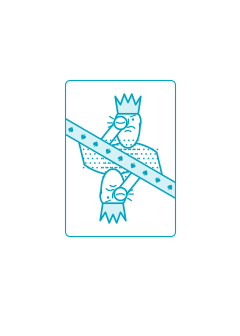 K♠ The Beast Every opponent discards their most recently collected card, from any suit. Shielded cards survive.
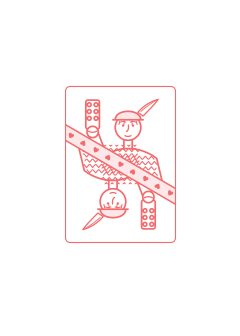 J♥ Verapamil Look at the top three cards of the pile. Keep one if its suit is unlocked for you; return the rest to the top in any order.
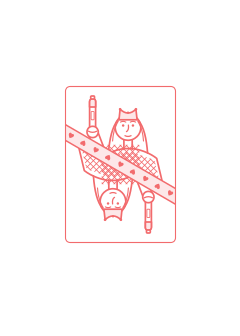 Q♥ Triptan SC Take another turn immediately after this one.
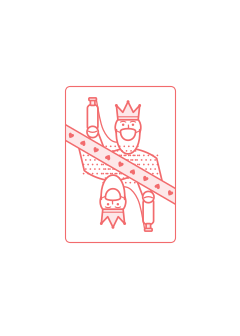 K♥ High-Flow O2 Choose one card in your collection and shield it. A shielded card can never be taken by The Beast or the Misdiagnosis.
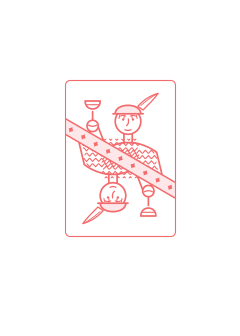 J♦ Alcohol Choose an opponent. They immediately draw two cards, resolved by their own unlock rules.
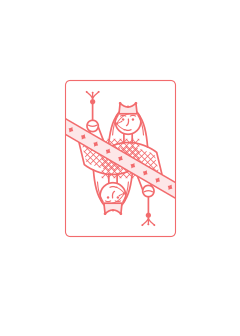 Q♦ Trigeminal V1 Turn order reverses. Clockwise becomes anticlockwise, or back again.
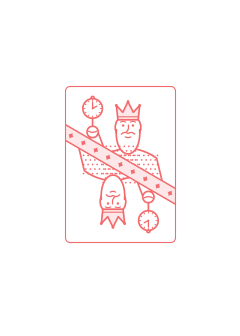 K♦ Circadian Draw again immediately. For the rest of the game your Diamonds are immune to the Misdiagnosis.
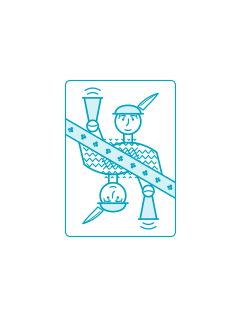 J♣ The Advocate Look at the top five cards of the pile and put them back in any order you choose.
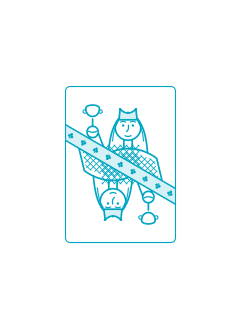 Q♣ The Caregiver Take any one card from anywhere in the discard pile, provided its suit is unlocked for you.
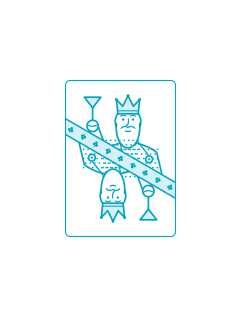 K♣ The Neurologist Every stage unlocks for you at once. From now on you may collect any suit.
Your fact deck
Every card carries a real clinical fact about cluster headache. A card joins your deck the first time you draw it. Tap a card to read it.0 of 54 collected
♠Spades · The Beast0 / 13
♥Hearts · The Shield0 / 13
♦Diamonds · The Clock0 / 13
♣Clubs · The Circle0 / 13
★Jokers0 / 2
Where the facts come fromEvery clinical fact printed on a card is drawn from the published literature: the International Classification of Headache Disorders (ICHD-3, Cephalalgia 2018), the European Academy of Neurology guideline on the treatment of cluster headache (Eur J Neurol 2023), the randomised trials of high-flow oxygen (JAMA 2009) and subcutaneous sumatriptan (N Engl J Med 1991), and published patient-survey data. The Kip scale and the name “the Beast” both come from the patient community, not from clinical research.These games are an awareness and education tool. They are not a diagnostic aid and not a substitute for medical advice.